OrchardBench

A Physically-Grounded, GPU-Parallel Apple-Orchard Simulation Benchmark for Agricultural Robotics
Humphrey Munn
School of EECS, The University of Queensland

Abstract

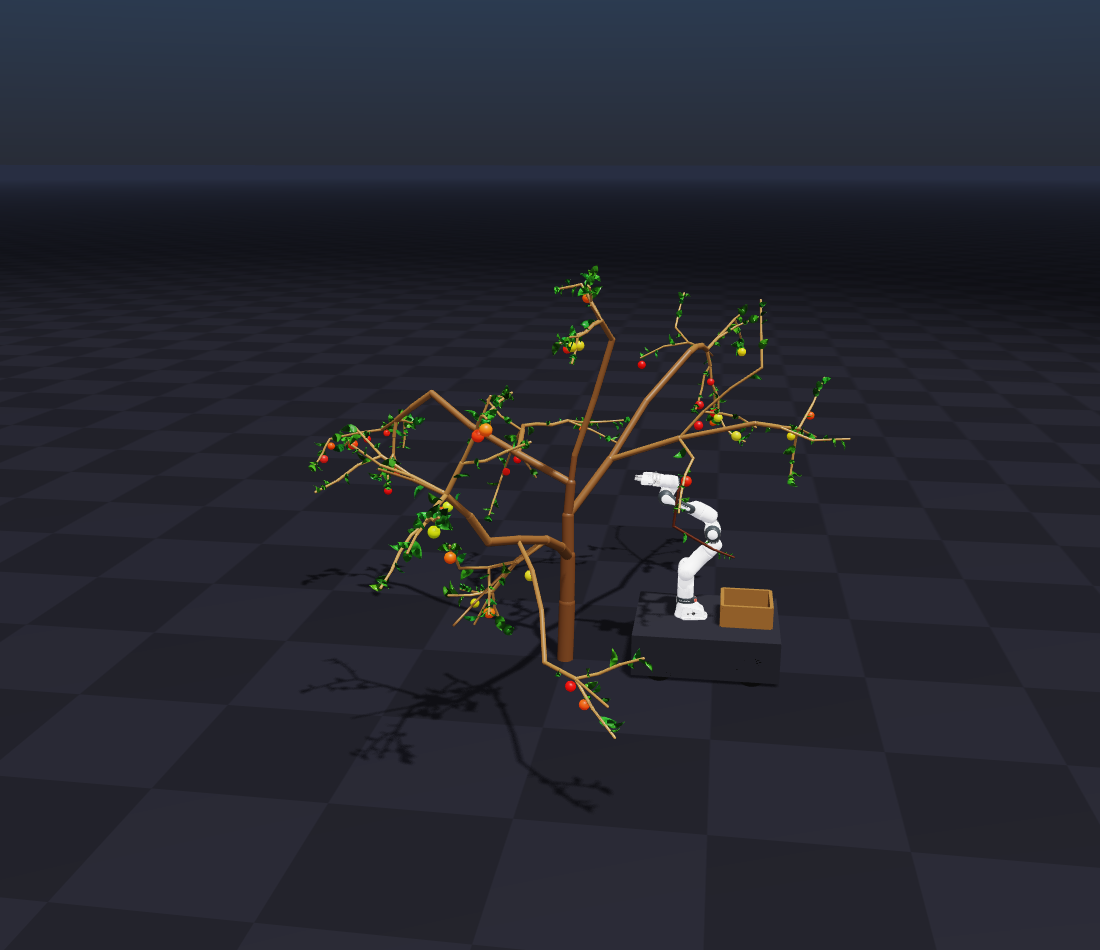
Robotic tree-fruit harvesting is a flagship problem for agricultural automation, but progress is bottlenecked by the cost and irreproducibility of field experiments: an orchard is available only weeks a year, every tree is different, and a control error can permanently damage the crop. The tree models used in graphics and agronomy are geometrically detailed but physically inert, while the GPU-parallel simulators used in robot learning contain no plausible trees. We present OrchardBench, a physically-grounded, GPU-parallel simulation of apple-orchard trees on the NVIDIA Newton / MuJoCo-Warp engine. Each tree is grown by a stochastic L-system and instantiated as a fully articulated body: branches are compliant torsional spring-dampers that break at a wood modulus of rupture and fall as free hinges, and apples are independent bodies on stem tethers that detach at literature-grounded pull forces and load the branch as they are pulled. A moving, density-controllable foliage layer occludes the canopy as real leaves do. Every physical parameter is tied to a published source. Per-environment domain randomization makes each batched world a distinct tree, and a mobile manipulator with a wrist depth camera closes the loop with geometric fruit perception and an autonomous harvesting baseline. Careful engineering of the solver and the model lets OrchardBench run many parallel environments at interactive rates on a single 8 GB laptop GPU.

What's in the benchmark

Parallel at laptop scale

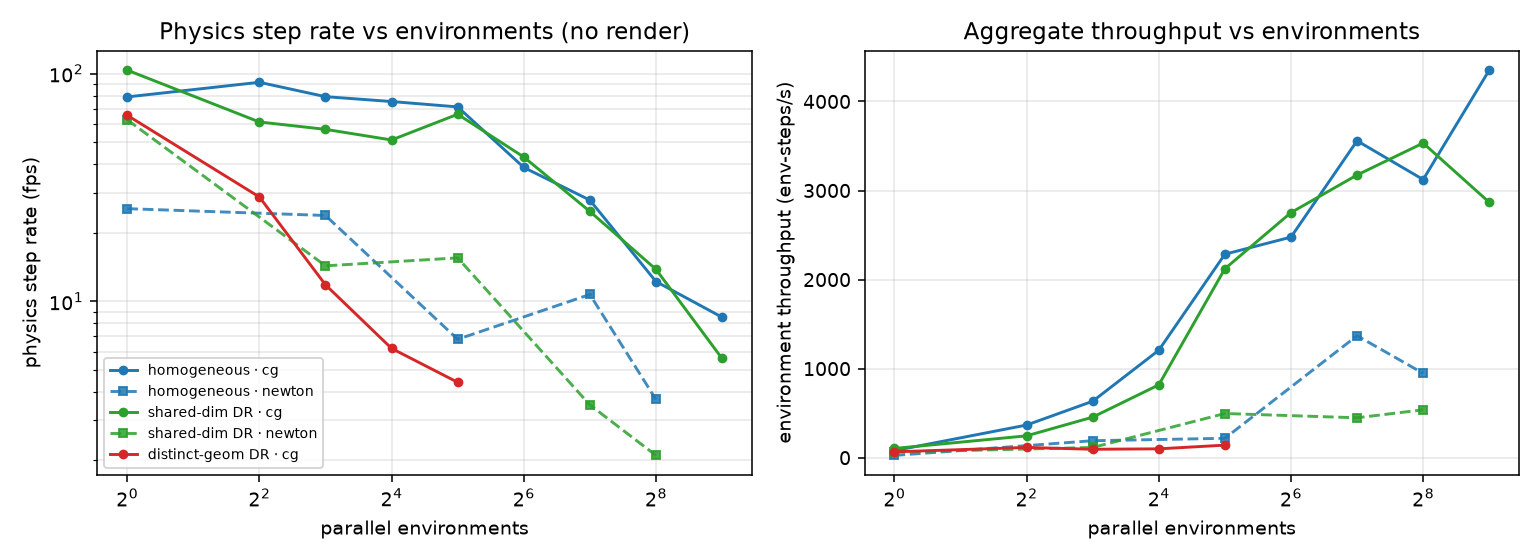
Shared-dimension domain-randomized batches step at essentially the homogeneous rate and scale to hundreds of trees on a single 8 GB laptop GPU; per-environment distinct geometry is the one axis that gates the batched solve. The matrix-free conjugate-gradient solver is what makes laptop-scale batches practical.

Physics step rate and throughput vs number of parallel trees
Physics step rate (left) and aggregate throughput (right) versus the number of parallel trees, for three randomization modes and both constraint solvers.

Contact, breaking, and perception

A branch breaking under robot contact
Branches rupture under robot contact and fall as free hinges.
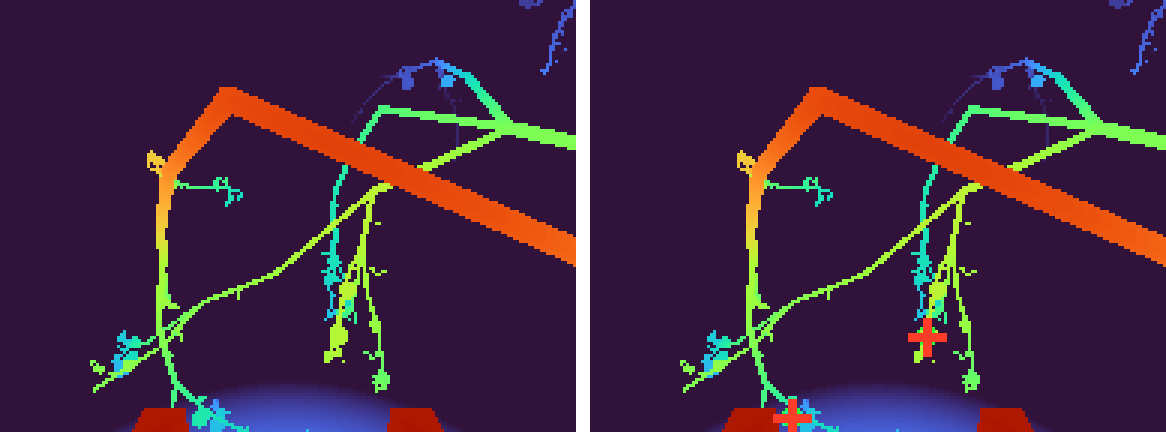
Wrist depth camera and geometric fruit detection
Wrist depth camera (left) and geometric sphere-fit fruit detection (right).

Citation

OrchardBench is described in our arXiv preprint, arXiv:2607.06337. If you use OrchardBench, please cite:

@misc{munn2026orchardbench,
  title         = {OrchardBench: A Physically-Grounded, GPU-Parallel Apple-Orchard
                   Simulation Benchmark for Agricultural Robotics},
  author        = {Munn, Humphrey},
  year          = {2026},
  eprint        = {2607.06337},
  archivePrefix = {arXiv},
  primaryClass  = {cs.RO}
}

License

OrchardBench is open source under the Apache License 2.0 — free to use, modify and distribute (including commercially), with an explicit patent grant. The full terms are in the LICENSE.